The Growing Importance of Lifelong Learning 📚🌱
Education has traditionally been associated with childhood, school, college, and university. For generations, many people followed a relatively straightforward path: complete formal education, find a job, build a career, and eventually retire.
Today, that model is changing.
Technology is transforming industries, new professions are emerging, workplace expectations are evolving, and knowledge is becoming outdated faster than ever. Skills that were highly valuable a decade ago may need to be updated, expanded, or replaced. At the same time, people are living and working in increasingly complex environments.
These changes have made lifelong learning more important than ever.
Lifelong learning refers to the continuous pursuit of knowledge, skills, experiences, and personal development throughout a person’s life. It can happen inside traditional educational institutions, but it can also happen through online courses, professional training, books, workshops, hobbies, mentoring, communities, practical experiences, and everyday exploration.


The idea is simple:
Learning does not have an expiration date.
Whether someone is 18, 35, 55, or 75, there are always opportunities to learn something new.
Lifelong learning can help people remain adaptable, develop confidence, discover new interests, improve career opportunities, and participate more actively in an increasingly changing society.
In this article, we explore why lifelong learning is becoming essential, how it benefits individuals and organizations, the role of technology, common barriers to continuous learning, and how anyone can develop a sustainable lifelong-learning mindset.
What Is Lifelong Learning? 🧠
Lifelong learning is the ongoing process of acquiring knowledge and developing skills throughout life.
It does not necessarily mean continuously earning degrees.
A person can be a lifelong learner by:
- Taking an online course
- Learning a new language
- Reading books
- Attending workshops
- Developing professional skills
- Learning to use new technology
- Studying history or science
- Learning a musical instrument
- Joining a professional community
- Practicing a new hobby
- Learning from mentors
- Participating in community activities
- Exploring unfamiliar subjects
This makes lifelong learning different from traditional education.
Formal education usually follows a structured curriculum, defined timetable, and recognized qualification.
Lifelong learning can be much more flexible.
A person might spend six months learning data analysis, then study photography for personal enjoyment, followed by a course in communication skills.
The learner decides what to learn, why to learn it, and often how to learn it.
Why Lifelong Learning Matters More Than Ever 🌍
The modern world changes rapidly.
Technological developments can transform workplaces in just a few years. Artificial intelligence, automation, cloud computing, digital communication, biotechnology, renewable energy, and other innovations are creating new opportunities while changing existing jobs.
This means education cannot end when someone receives a diploma.
A degree may provide a strong foundation, but professional growth often requires continuous development.
Consider someone who studied marketing several years ago.
Traditional marketing knowledge may still be useful, but today’s marketer may also need to understand social media, digital analytics, search strategies, content creation, automation, artificial intelligence, and changing consumer behavior.
The same pattern appears across many professions.
Doctors need to keep up with medical developments.
Teachers need to understand new educational technologies.
Engineers need to adapt to changing tools.
Managers need new approaches to leadership.
Designers need to learn new software.
Business owners need to understand changing markets.
Continuous learning allows people to remain adaptable.
1. Lifelong Learning Helps People Adapt to Change 🔄
Change is unavoidable.
The question is not whether people will experience change but how effectively they will respond to it.
People who continue learning may be better prepared to adapt when circumstances change.
Suppose a company introduces a new software system.
An employee who is comfortable learning new technology may approach the change as an opportunity to develop a new skill.
Someone who strongly resists learning may experience greater difficulty.
Lifelong learning encourages a growth-oriented attitude:
“I don’t know this yet, but I can learn it.”
This mindset can make unfamiliar situations less intimidating.
Adaptability Is a Modern Skill
Employers increasingly value people who can learn and adapt.
Technical knowledge matters, but the ability to acquire new knowledge can be equally valuable.
A worker who learns quickly can potentially transition between tools, responsibilities, and roles more effectively.
This is why lifelong learning is not only about accumulating information.
It is about developing the ability to keep learning.
2. It Can Improve Career Opportunities 💼🚀
Career development is one of the most obvious benefits of lifelong learning.
Professional environments are constantly evolving, and employees may need additional skills to qualify for new responsibilities.
Learning can help people:
- Strengthen existing skills
- Develop specialized knowledge
- Prepare for promotions
- Change careers
- Improve professional confidence
- Understand new technologies
- Build professional portfolios
- Demonstrate initiative
For example, an employee working in administration might learn data analysis.
A graphic designer might develop user-experience skills.
A teacher might learn educational technology.
A business professional might study project management.
These additional capabilities can create new career possibilities.
Learning Does Not Always Mean Going Back to University
One common misconception is that career development requires another full degree.
That is not always necessary.
Short courses, certifications, workshops, practical projects, professional communities, and self-directed learning can all contribute to skill development.
The best learning pathway depends on the individual’s goals.
3. Lifelong Learning Builds Confidence 🌟
Learning something new can be challenging.
At first, a person may feel uncomfortable or uncertain.
But gradually, understanding develops.
The learner solves a problem that previously seemed difficult.
That experience can build confidence.
For example, someone who has never used a programming language might initially find coding confusing.
After completing several small projects, however, the learner may realize:
“I can actually do this.”
That confidence can extend beyond the original subject.
Learning teaches people that difficult things can become manageable through practice.
This can encourage individuals to take on new challenges.
4. It Supports Personal Growth 🌱
Lifelong learning is not only about careers.
People can learn simply because they are curious.
Someone might study:
- Philosophy
- Psychology
- Literature
- Astronomy
- History
- Music
- Cooking
- Photography
- Gardening
- Art
- Languages
- Culture
These interests can make life richer.
Learning gives people opportunities to explore questions they have always wondered about.
It can also help individuals discover interests they never knew they had.
Imagine someone taking a beginner photography course simply for fun.
That experience might lead to a lifelong hobby.
Another person might learn a new language and develop an interest in another culture.
A hobby can become a source of creativity, community, and personal satisfaction.
5. Lifelong Learning Encourages Critical Thinking 🔍
In a world filled with enormous amounts of information, knowing how to evaluate information is increasingly important.
People encounter claims through:
- Social media
- News websites
- Videos
- Blogs
- Advertising
- Online communities
- Artificial intelligence tools
Not all information is accurate.
Lifelong learning encourages people to ask questions.
Where did this information come from?
What evidence supports it?
Are there alternative explanations?
Is the source reliable?
This habit of inquiry can strengthen critical thinking.
Education therefore becomes more than the accumulation of facts.
It becomes a process of learning how to think.
6. Technology Has Made Lifelong Learning More Accessible 💻🌐
Technology has dramatically expanded access to educational resources.
In the past, learning a specialized subject might require traveling to a library, attending a physical institution, or purchasing expensive materials.
Today, people can access educational content from almost anywhere.
Online platforms can provide:
- Video lessons
- Digital textbooks
- Interactive exercises
- Recorded lectures
- Online communities
- Practice assessments
- Virtual workshops
- Professional courses
A learner can study early in the morning, during a lunch break, or in the evening.
This flexibility makes learning easier to integrate into busy lives.


Learning From Anywhere
A person living in a small town does not necessarily need to relocate to a major city to access high-quality educational material.
Digital education can connect learners with instructors, experts, institutions, and communities across geographic boundaries.
This has the potential to make education more flexible and inclusive.
However, access to devices, reliable internet, digital literacy, and high-quality resources still varies between communities.
Technology creates opportunities, but equitable access remains important.
7. Artificial Intelligence Could Personalize Learning 🤖📚
Artificial intelligence is creating new possibilities for education.
AI-powered learning tools can potentially help learners identify areas where they need additional practice, generate explanations, provide exercises, summarize complex concepts, and offer interactive assistance.
For lifelong learners, this could make self-directed education more convenient.
For example, someone learning a language might use an AI-based system to practice conversations.
A student studying mathematics might ask for additional examples.
A professional learning a technical subject might request explanations at different levels of complexity.
However, AI should be used thoughtfully.
Learners still need to verify information, develop independent thinking, and use reliable sources.
The goal should be to use AI as a learning assistant—not as a replacement for thinking.
8. Lifelong Learning Can Support Career Changes 🔄💼
People no longer necessarily remain in the same profession throughout their entire working lives.
Economic changes, personal interests, technological developments, and changing priorities can all lead people toward new careers.
Lifelong learning can make career transitions more achievable.
For example, someone working in customer service might decide to move into digital marketing.
They could begin by studying:
- Marketing fundamentals
- Content creation
- Social media
- Analytics
- Search strategies
- Digital advertising
They could then create practical projects to demonstrate their skills.
The transition may take time, but continuous learning creates a pathway.
Career Reinvention Is Becoming More Normal
Changing careers does not necessarily mean starting from zero.
People carry transferable skills from previous experiences.
Communication, organization, teamwork, leadership, research, problem-solving, and customer understanding can be valuable across industries.
New learning can build on those existing strengths.
9. Organizations Also Benefit From Lifelong Learning 🏢📈
Lifelong learning is not only an individual responsibility.
Organizations have an important role to play.
Companies that invest in employee development can build stronger internal capabilities.
Training programs can help workers understand:
- New technologies
- Industry developments
- Leadership
- Communication
- Cybersecurity
- Data analysis
- Project management
- Customer service
- Workplace safety
Continuous professional development can also help organizations respond to changing markets.
Instead of constantly searching for new talent, companies can sometimes develop existing employees for emerging responsibilities.
A Learning Culture
A strong organization can create a culture where learning is viewed as part of work rather than an occasional activity.
Managers can encourage employees to:
- Attend workshops
- Share knowledge
- Experiment
- Learn from mistakes
- Mentor colleagues
- Develop new skills
- Reflect on projects
When learning becomes part of organizational culture, employees may feel more supported in their professional development.
10. Lifelong Learning Can Strengthen Communities 🏘️🤝
The benefits of education extend beyond individuals.
Communities with opportunities for learning can become more informed, adaptable, and connected.
Community learning can include:
- Public workshops
- Libraries
- Adult education programs
- Skill-sharing groups
- Cultural activities
- Community technology programs
- Local discussion groups
People can learn from one another.
A retired professional might teach financial literacy.
A local artist might teach painting.
A technology enthusiast might teach basic digital skills.
This exchange of knowledge strengthens community connections.
11. It Encourages Intergenerational Learning 👵👨🎓
Learning does not belong to one age group.
Young people can learn from older generations’ experiences, while older adults can learn new technologies and perspectives from younger people.
For example, a teenager might help a grandparent understand a digital application.
The grandparent might share knowledge about traditional skills, history, or personal experiences.
This creates a two-way exchange.
Intergenerational learning can reduce stereotypes and encourage mutual understanding.
12. Learning Can Become a Habit 🗓️📖
One of the most effective ways to embrace lifelong learning is to make it part of everyday life.
People do not need to study for several hours every day.
Small, consistent habits can produce meaningful progress.
For example:
15 minutes: Read an article.
20 minutes: Watch an educational lecture.
30 minutes: Practice a new skill.
45 minutes: Complete an online lesson.
One hour: Work on a personal project.
Consistency matters more than intensity.
A person who learns for 20 minutes several times a week can accumulate substantial knowledge over months and years.
13. Lifelong Learning Helps People Stay Curious 🔎✨
Curiosity is one of the strongest drivers of learning.
Children naturally ask questions.
Why is the sky blue?
How do airplanes fly?
Why do plants grow?
How does the internet work?
As people grow older, busy schedules can sometimes reduce the time available for curiosity.
Lifelong learning can help restore that sense of exploration.
Instead of thinking:
“I’m too old to learn this.”
A lifelong learner asks:
“What could I discover if I tried?”
That simple shift can open new possibilities.
Common Barriers to Lifelong Learning 🚧
Although lifelong learning offers many benefits, people often face obstacles.
Lack of Time
Work, family responsibilities, and daily commitments can make learning difficult.
The solution may be to start small.
Instead of waiting for a free weekend, learners can create short, regular study periods.
Cost
Some courses and programs can be expensive.
Fortunately, many free or low-cost educational resources are available.
Libraries, open educational resources, community programs, public lectures, and free online materials can provide useful alternatives.
Fear of Failure
Adults sometimes worry that they will struggle with a new subject.
This is particularly common when learning technology or unfamiliar academic topics.
It is important to remember that being a beginner is normal.
Nobody starts as an expert.
Information Overload
Modern learners have almost unlimited information available.
This can become overwhelming.
A better approach is to choose a specific goal and follow a structured learning path.
How to Become a Lifelong Learner 🎯
Anyone can develop a lifelong-learning habit.
1. Identify Your Interests
Start with a subject you genuinely care about.
Curiosity makes learning easier to sustain.
2. Set a Clear Goal
Instead of saying, “I want to learn technology,” create a specific goal:
“I want to learn the basics of data analysis within three months.”
3. Choose a Learning Format
Decide whether you learn best through:
- Books
- Videos
- Courses
- Practice
- Discussions
- Projects
- Mentorship
4. Create a Schedule
Set aside regular time.
Even 20 minutes can be valuable.
5. Practice What You Learn
Knowledge becomes more useful when applied.
Create projects, solve problems, explain concepts, or teach someone else.
6. Track Your Progress
Keep notes about what you have learned.
Seeing progress can increase motivation.
7. Don’t Fear Mistakes
Mistakes provide feedback.
Treat them as part of the learning process.
The Future of Lifelong Learning 🚀
The future of education may become increasingly flexible.
Instead of thinking about education as something that happens primarily during the first 20 years of life, society may increasingly view learning as a continuous process.
People may move between:
Education → Employment → Learning → Career Change → Further Education → New Skills → Personal Development
This cycle could continue throughout life.
Technology will likely play an increasingly important role.
AI tutors, immersive learning environments, virtual classrooms, digital credentials, personalized educational platforms, and collaborative online communities may provide learners with more options.
But technology will only be one part of the future.
Human curiosity, teachers, mentors, peers, books, communities, and real-world experiences will remain important.
Lifelong Learning in an AI-Driven World 🤖🌍
Artificial intelligence makes lifelong learning even more important.
As AI automates certain tasks, people may need to develop skills that complement technology.
These can include:
- Critical thinking
- Creativity
- Communication
- Leadership
- Problem-solving
- Collaboration
- Adaptability
- Digital literacy
- Ethical reasoning
The goal is not simply to compete with machines.
It is to learn how to work effectively alongside increasingly capable technologies.
People who continue developing their knowledge may be better prepared to understand technological changes and make informed decisions about how to use them.
Conclusion: Learning Never Has to Stop 🌱📚
The growing importance of lifelong learning reflects a simple reality: the world does not stop changing when formal education ends.
Technology evolves.
Industries transform.
Careers change.
New discoveries emerge.
Personal interests develop.
Life itself presents new challenges and opportunities.
Continuous learning gives people a way to respond.
Lifelong learning can strengthen careers, increase confidence, encourage curiosity, improve critical thinking, support personal development, and help people adapt to change.
Most importantly, it changes the way we think about education.
Education is not merely something we complete.
It is something we continue.
A person does not need to become an expert in everything. They simply need to remain curious, open-minded, and willing to grow.
Whether through a book, a course, a conversation, a new technology, a hobby, or a challenging experience, every day can provide an opportunity to learn something new.
The future will belong not necessarily to those who know everything today, but to those who are willing and able to keep learning tomorrow. 🌟
Keep learning. Keep exploring. Keep growing. 🚀📖
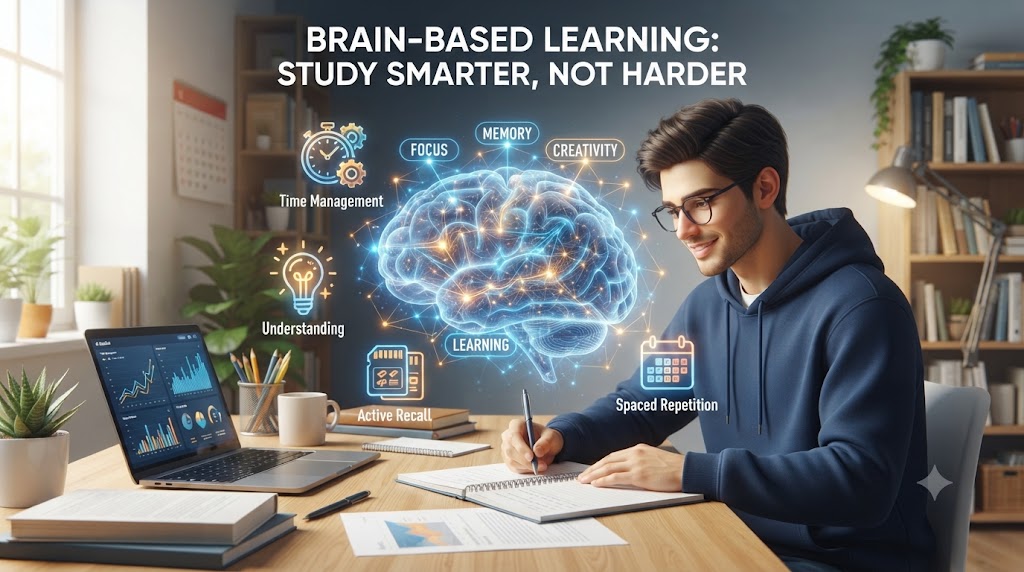
🧠 Brain-Based Learning: How to Study Smarter, Not Harder
Introduction: Understanding How Your Brain Learns
Studying for hours does not always guarantee success. Many students spend countless hours reading textbooks, highlighting notes, and repeating information, yet struggle to remember what they studied. The reason is simple: effective learning depends on how the brain processes, stores, and retrieves information.
Brain-based learning uses knowledge from neuroscience and psychology to create study methods that match the natural working style of the brain. Instead of forcing yourself to study harder, you learn how to study smarter by improving focus, memory, understanding, and long-term retention.
genui{“biology_neuroscience_behavior_senses_learning_block”:{“type_id”:”SYNAPTIC_TRANSMISSION”,”locale_override”:”en-US”}}
🧠 How Your Brain Stores Information
The human brain is designed to learn through connections. Every time you learn something new, your brain creates and strengthens pathways between neurons. The stronger these connections become, the easier it is to recall information later.
Learning happens through three major processes:
1. Encoding: Taking In New Information
Encoding is the first step of learning. Your brain receives information through reading, listening, watching, or practicing. However, simply seeing information does not mean your brain has learned it.
To improve encoding:
- Connect new information with things you already know
- Use examples and real-life situations
- Ask questions while studying
- Explain concepts in your own words
2. Consolidation: Making Knowledge Permanent
After learning, your brain needs time to organize and store information. Sleep plays a major role in this process.
During sleep, the brain strengthens important memories and removes unnecessary information. A tired brain may study for hours but remember very little.
Better habits:
- Sleep 7–9 hours regularly
- Review material before sleeping
- Avoid all-night study sessions
3. Retrieval: Bringing Information Back
The strongest learners do not only read information repeatedly. They practice recalling it.
Examples:
- Taking practice tests
- Answering questions without looking at notes
- Teaching someone else
- Writing summaries from memory
Retrieval practice trains your brain to access information quickly during exams.
📚 Study Smarter With These Brain-Based Techniques
1. Use Active Recall Instead of Passive Reading
Many students read the same chapter again and again thinking they are learning. However, passive reading creates a false feeling of familiarity.
Active recall forces your brain to retrieve information.
Try this method:
Instead of reading:
❌ “I read the chapter five times.”
Do this:
✅ “I close the book and explain what I remember.”
Examples:
- Create flashcards
- Solve questions
- Write key points from memory
- Teach the topic to someone
Active recall strengthens memory pathways.
⏳ 2. Apply the Spaced Repetition Method
The brain forgets information when it is not reviewed. Spaced repetition prevents forgetting by reviewing information at increasing intervals.
Example schedule:
📅 Day 1: Learn the topic
📅 Day 3: Quick review
📅 Day 7: Practice again
📅 Day 14: Review important points
📅 Day 30: Final revision
This method helps move information from short-term memory into long-term memory.
🎯 3. Study in Focused Sessions
The brain cannot maintain maximum concentration for many hours continuously.
Instead of studying for 6 hours without breaks, use focused study cycles.
The Pomodoro Technique:
🍅 Study for 25–50 minutes
☕ Take a 5–10 minute break
🔁 Repeat the cycle
During breaks:
- Stretch
- Drink water
- Walk around
- Avoid excessive phone scrolling
Short breaks refresh your brain and improve concentration.
🌱 4. Understand Before Memorizing
The brain remembers meaningful information better than random facts.
For example:
Instead of memorizing:
“Photosynthesis occurs in chloroplasts.”
Understand:
“Plants use chloroplasts like tiny food factories that convert sunlight into energy.”
When information has meaning, your brain creates stronger connections.
✍️ 5. Use the Feynman Technique
The Feynman Technique is one of the best ways to check your understanding.
Follow these steps:
Step 1: Choose a topic
Pick something you want to learn.
Step 2: Explain it simply
Pretend you are teaching a child.
Step 3: Find gaps
Notice what parts you cannot explain.
Step 4: Improve your understanding
Study those weak areas and explain again.
If you can teach it simply, you truly understand it.
🧩 6. Combine Different Learning Methods
The brain learns better when multiple senses are involved.
Try combining:
👀 Visual learning:
- Diagrams
- Mind maps
- Charts
👂 Auditory learning:
- Explaining aloud
- Discussions
- Educational videos
✍️ Writing:
- Notes
- Summaries
- Practice answers
🖐 Practical learning:
- Experiments
- Real-life applications
Multiple learning pathways create stronger memories.
🧘 7. Train Your Brain for Better Focus
Modern distractions make concentration difficult. A distracted brain cannot learn efficiently.
Improve focus by:
📱 Keeping your phone away while studying
🎧 Studying in a quiet environment
📝 Creating daily goals
🌿 Practicing mindfulness or meditation
🎯 Studying one topic at a time
Deep focus creates deeper learning.
🥗 8. Feed Your Brain Properly
Your brain requires energy to learn effectively.
Brain-friendly foods include:
🥜 Nuts and seeds
🐟 Omega-3-rich foods
🍎 Fruits
🥦 Vegetables
🥚 Eggs
💧 Plenty of water
Avoid excessive junk food and dehydration because they can reduce concentration.
😴 9. Never Underestimate Sleep
Sleep is not wasted study time. It is when your brain organizes learning.
Benefits of good sleep:
✅ Better memory
✅ Improved problem-solving
✅ Increased attention
✅ Better emotional control
Studying late at night while sacrificing sleep often reduces performance.
🏃 10. Exercise for a Smarter Brain
Physical activity improves blood flow to the brain and supports mental performance.
Simple activities:
🚶 Walking
🧘 Yoga
🏃 Light exercise
🏸 Sports
Even 20–30 minutes of movement can improve mood and concentration.
📖 Example of a Brain-Based Study Routine
Morning (High Energy)
🌅 Review difficult concepts
📚 Learn new topics
✍ Practice active recall
Afternoon
📝 Solve questions
🔄 Review previous lessons
Evening
📖 Light revision
🧠 Create summaries
😴 Prepare for quality sleep
Common Study Mistakes That Waste Brain Power
❌ Studying Without Breaks
Long sessions reduce attention and increase fatigue.
❌ Memorizing Without Understanding
Information without meaning disappears quickly.
❌ Multitasking
Switching between tasks reduces learning efficiency.
❌ Ignoring Revision
Without repetition, memories weaken.
❌ Studying Only Before Exams
Last-minute learning creates stress and poor retention.
🧠 The Science of Becoming a Better Learner
Being a successful student is not about having a “perfect memory.” It is about using strategies that work with your brain.
The best learners:
✔ Ask questions
✔ Practice regularly
✔ Review strategically
✔ Understand concepts deeply
✔ Take care of their health
Your brain has the ability to change and adapt through a process called neuroplasticity. Every time you practice, learn, and challenge yourself, your brain becomes better at learning.
Conclusion: Study Smarter, Grow Faster
Brain-based learning teaches us that studying is not about spending more hours with books. It is about using effective methods that help your brain absorb and remember information.
By using active recall, spaced repetition, proper sleep, focused study sessions, exercise, and meaningful learning techniques, you can improve your academic performance while reducing stress.
Remember: A smarter study method can achieve more than endless hours of ineffective studying. Train your brain, understand your learning style, and make every study session count.