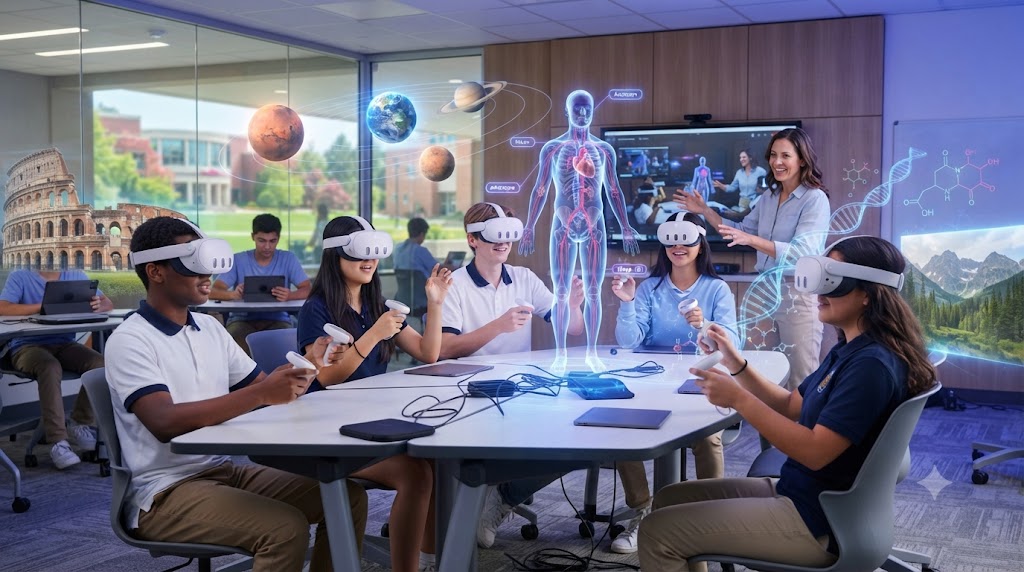
🥽 Virtual Reality in Education: Creating Immersive Learning Experiences
Imagine a student exploring ancient civilizations without leaving the classroom, examining the human heart in three dimensions, walking across the surface of Mars, or practicing a complex technical procedure inside a safe virtual environment.
This is the promise of virtual reality (VR) in education.
Virtual reality is moving beyond entertainment and becoming an increasingly interesting educational technology. By creating computer-generated environments that students can explore and interact with, VR can transform some lessons from passive experiences into immersive activities.


However, VR is not simply about putting a headset on a student. Its educational value depends on how thoughtfully the technology is connected to curriculum goals, teaching methods, accessibility, and student needs.
🥽 What Is Virtual Reality in Education?
Virtual reality uses digital technology to create an interactive environment that can give users the feeling of being inside a simulated world.
In education, students can use VR headsets and other devices to explore environments that may be difficult, expensive, dangerous, or impossible to experience physically.
A history class might use VR to explore a reconstruction of an ancient city. A biology lesson could allow students to examine a three-dimensional model of the human body. Geography students could explore landscapes and ecosystems.
The objective is not simply to make lessons visually impressive. The goal is to create experiences that help students understand concepts more deeply.
🌍 Learning Through Experience
Traditional education often relies on explanations, diagrams, photographs, videos, and textbooks.
These methods remain valuable, but VR adds another possibility: experiential learning.
Instead of simply reading about the solar system, students could explore a virtual planetary environment.
Instead of looking at a diagram of a volcano, they could examine a simulated volcanic landscape.
Instead of reading about architectural structures, students could walk through virtual versions of them.


This ability to explore can make abstract subjects more tangible.
🧠 How VR Can Support Engagement
One potential advantage of VR is its ability to create an immersive environment.
When students interact directly with a virtual setting, they may become more actively involved in the learning activity.
A lesson can become a sequence of exploration, observation, decision-making, and problem-solving rather than simply listening to an explanation.
For example, a science lesson could ask students to identify different organisms within a virtual ecosystem. Students would not merely memorize definitions; they would observe relationships between elements in the simulated environment.
🔬 VR for Science Education
Science is one area where immersive learning can be particularly useful.
Students can explore microscopic structures, examine astronomical environments, investigate geological formations, or conduct simulated experiments.
Virtual laboratories can also provide controlled environments for practicing procedures.
For subjects where physical equipment is expensive or difficult to access, simulations may provide an additional learning opportunity.
VR does not necessarily replace real laboratories. Instead, it can supplement physical experimentation by allowing students to practice concepts before working with real equipment.
🫀 Medical and Healthcare Education
Healthcare education involves many situations where students need opportunities to understand anatomy, procedures, and decision-making.
VR can create three-dimensional representations of anatomical structures and simulated clinical environments.


Students may be able to examine organs from different angles, explore body systems, or practice certain simulated procedures.
Such technology can provide additional practice opportunities without requiring every learning activity to involve a real patient or physical facility.
For professional training, however, VR should generally be viewed as one component of a broader educational program rather than a universal replacement for supervised practical experience.
🏛️ History and Social Studies
History can sometimes feel distant when students encounter it primarily through dates, names, and written descriptions.
VR can provide another way to explore historical contexts.
Students could virtually examine reconstructed buildings, ancient settlements, museums, archaeological environments, or historically significant locations.
A virtual environment can help students visualize scale, architecture, geography, and daily life.
Teachers can then connect the experience to historical documents, evidence, discussion, and critical analysis.
The technology should support historical understanding rather than presenting a simulation as unquestionable historical reality.
🌌 Geography and Virtual Field Trips
Field trips can provide valuable educational experiences, but they are not always practical.
Travel costs, distance, safety, accessibility, and scheduling can limit opportunities.
Virtual reality can create alternative field-trip experiences.
Students might explore coral reefs, rainforests, glaciers, deserts, museums, archaeological sites, or outer-space environments.


Virtual field trips can also introduce students to places that would otherwise be inaccessible to them.
🧑🔬 Simulations for Practical Skills
Some skills are best learned through practice.
VR can create simulated environments where students can repeatedly perform tasks, make decisions, and learn from mistakes.
This can be useful in areas such as engineering, technical training, emergency response, aviation, healthcare, and vocational education.
A virtual simulation can allow learners to encounter scenarios without the same immediate consequences associated with making mistakes in a real-world environment.
However, simulation quality matters. Poorly designed experiences may teach unrealistic procedures or create a false sense of competence.
🎨 Creativity and Design
VR can also become a creative environment.
Students can construct three-dimensional objects, design spaces, explore virtual sculptures, create artistic environments, and experiment with digital models.
Architecture and design students can potentially walk through their own creations before physical construction.
Art students can experiment with three-dimensional forms that would be difficult to produce using traditional materials.
This makes VR not only a consumption technology but also a creation tool.
🤖 VR and Artificial Intelligence
The combination of VR and artificial intelligence could make immersive education more adaptive.
AI systems can potentially provide virtual tutors, generate scenarios, adjust challenges, or respond to student actions.
Imagine a language-learning environment where students enter a virtual café and practice conversations with AI-driven characters.
Or consider a science simulation where the virtual environment changes based on the student’s decisions.
These technologies could create increasingly personalized learning experiences.
Nevertheless, AI-generated content should be reviewed for accuracy and educational appropriateness.
👩🏫 The Teacher’s Role Remains Important
It is easy to imagine VR as a technology that teaches students independently.
In reality, the teacher remains central to the learning process.
Before a VR activity, teachers can introduce the concepts students need to understand. During the experience, they can guide observation and discussion. Afterward, they can help students connect what they experienced with academic concepts.
A VR session without preparation or reflection may become little more than an interesting digital experience.
The educational value comes from the complete learning process.
📚 VR Should Support the Curriculum
Technology should not be introduced simply because it is impressive.
Teachers can begin with a learning objective and then ask whether VR provides something valuable that another method cannot provide as effectively.
For example, if students need to memorize a definition, a VR environment may be unnecessary.
But if students need to understand spatial relationships, explore an inaccessible environment, or practice a complex scenario, immersive technology may offer additional value.
This principle can prevent technology from becoming a distraction.
⚠️ Challenges of Virtual Reality in Education
Despite its potential, VR faces several challenges.
💰 Cost
VR headsets, computers, software, maintenance, and technical support can require significant investment.
Schools with limited budgets may find large-scale implementation difficult.
🌐 Access
Students need appropriate hardware and software to participate. Differences in access can create inequalities between institutions and learners.
🤢 Physical Discomfort
Some users may experience motion sickness, eye strain, dizziness, or discomfort during VR sessions.
Educational institutions need appropriate usage guidelines and breaks.
🧑🏫 Teacher Training
Teachers need time and support to understand how VR works and how to integrate it into lessons effectively.
🔐 Privacy
VR systems can potentially collect information about users and their interactions. Privacy and data security therefore need careful consideration.
📚 Educational Quality
Not every VR application is academically useful. Schools need to evaluate content quality, accuracy, accessibility, and alignment with learning objectives.
♿ Accessibility and Inclusive Design
Educational technology should be designed for diverse learners.
Some students may have difficulty using headsets because of visual, physical, sensory, or other accessibility considerations.
Institutions should therefore provide alternative ways to participate when necessary.
VR should expand educational opportunities rather than create new barriers.
👥 Collaborative Virtual Reality
Although VR is often associated with individual experiences, it can also support collaboration.
Multiple students may participate in shared virtual environments where they solve problems, communicate, construct objects, or explore simulations together.


This could become particularly interesting for remote education, where students are geographically separated but need to work together.
📈 Measuring Learning Outcomes
An important question for educators is whether VR actually improves learning outcomes.
Engagement alone is not enough.
Students may enjoy an immersive experience without necessarily remembering the underlying concepts.
Educational institutions therefore need to evaluate whether VR activities improve understanding, retention, practical skills, problem-solving, or other intended outcomes.
Research and classroom assessment can help teachers determine where VR genuinely adds value.
🎓 What Students Should Know
Students should approach VR as a learning tool rather than simply an entertainment technology.
Before entering a virtual environment, they should understand the learning objective. During the activity, they should observe carefully and interact meaningfully.
Afterward, reflection is important.
Students can write notes, discuss what they observed, answer questions, solve related problems, or connect the experience to real-world situations.
This turns an immersive experience into a structured learning activity.
🔮 What Could the Future Look Like?
As hardware becomes more capable and educational software becomes more sophisticated, VR could become part of a broader ecosystem of immersive learning.
Students may move between physical classrooms, online platforms, augmented reality, virtual reality, simulations, and AI-powered educational environments.
Rather than replacing traditional education, these technologies could provide additional ways to explore difficult concepts.
The future classroom may therefore be less about choosing between physical and digital environments and more about selecting the right environment for a particular learning objective.
🌟 Conclusion
Virtual reality has the potential to make education more immersive by allowing students to explore places, objects, scenarios, and concepts that are difficult to experience through conventional teaching alone.
From science laboratories and medical training to historical exploration, virtual field trips, engineering simulations, and creative design, VR can provide new opportunities for experiential learning.
But successful VR education requires more than expensive headsets. It needs thoughtful curriculum design, trained teachers, accessible technology, reliable content, privacy protections, and meaningful assessment.
The most promising role for VR is therefore not to replace teachers or traditional learning. It is to expand what students can experience, practice, and explore.
When immersive technology is connected to strong teaching, it can become another powerful tool for helping students understand the world around them.
The Growing Importance of Lifelong Learning 📚🌱
Education has traditionally been associated with childhood, school, college, and university. For generations, many people followed a relatively straightforward path: complete formal education, find a job, build a career, and eventually retire.
Today, that model is changing.
Technology is transforming industries, new professions are emerging, workplace expectations are evolving, and knowledge is becoming outdated faster than ever. Skills that were highly valuable a decade ago may need to be updated, expanded, or replaced. At the same time, people are living and working in increasingly complex environments.
These changes have made lifelong learning more important than ever.
Lifelong learning refers to the continuous pursuit of knowledge, skills, experiences, and personal development throughout a person’s life. It can happen inside traditional educational institutions, but it can also happen through online courses, professional training, books, workshops, hobbies, mentoring, communities, practical experiences, and everyday exploration.


The idea is simple:
Learning does not have an expiration date.
Whether someone is 18, 35, 55, or 75, there are always opportunities to learn something new.
Lifelong learning can help people remain adaptable, develop confidence, discover new interests, improve career opportunities, and participate more actively in an increasingly changing society.
In this article, we explore why lifelong learning is becoming essential, how it benefits individuals and organizations, the role of technology, common barriers to continuous learning, and how anyone can develop a sustainable lifelong-learning mindset.
What Is Lifelong Learning? 🧠
Lifelong learning is the ongoing process of acquiring knowledge and developing skills throughout life.
It does not necessarily mean continuously earning degrees.
A person can be a lifelong learner by:
- Taking an online course
- Learning a new language
- Reading books
- Attending workshops
- Developing professional skills
- Learning to use new technology
- Studying history or science
- Learning a musical instrument
- Joining a professional community
- Practicing a new hobby
- Learning from mentors
- Participating in community activities
- Exploring unfamiliar subjects
This makes lifelong learning different from traditional education.
Formal education usually follows a structured curriculum, defined timetable, and recognized qualification.
Lifelong learning can be much more flexible.
A person might spend six months learning data analysis, then study photography for personal enjoyment, followed by a course in communication skills.
The learner decides what to learn, why to learn it, and often how to learn it.
Why Lifelong Learning Matters More Than Ever 🌍
The modern world changes rapidly.
Technological developments can transform workplaces in just a few years. Artificial intelligence, automation, cloud computing, digital communication, biotechnology, renewable energy, and other innovations are creating new opportunities while changing existing jobs.
This means education cannot end when someone receives a diploma.
A degree may provide a strong foundation, but professional growth often requires continuous development.
Consider someone who studied marketing several years ago.
Traditional marketing knowledge may still be useful, but today’s marketer may also need to understand social media, digital analytics, search strategies, content creation, automation, artificial intelligence, and changing consumer behavior.
The same pattern appears across many professions.
Doctors need to keep up with medical developments.
Teachers need to understand new educational technologies.
Engineers need to adapt to changing tools.
Managers need new approaches to leadership.
Designers need to learn new software.
Business owners need to understand changing markets.
Continuous learning allows people to remain adaptable.
1. Lifelong Learning Helps People Adapt to Change 🔄
Change is unavoidable.
The question is not whether people will experience change but how effectively they will respond to it.
People who continue learning may be better prepared to adapt when circumstances change.
Suppose a company introduces a new software system.
An employee who is comfortable learning new technology may approach the change as an opportunity to develop a new skill.
Someone who strongly resists learning may experience greater difficulty.
Lifelong learning encourages a growth-oriented attitude:
“I don’t know this yet, but I can learn it.”
This mindset can make unfamiliar situations less intimidating.
Adaptability Is a Modern Skill
Employers increasingly value people who can learn and adapt.
Technical knowledge matters, but the ability to acquire new knowledge can be equally valuable.
A worker who learns quickly can potentially transition between tools, responsibilities, and roles more effectively.
This is why lifelong learning is not only about accumulating information.
It is about developing the ability to keep learning.
2. It Can Improve Career Opportunities 💼🚀
Career development is one of the most obvious benefits of lifelong learning.
Professional environments are constantly evolving, and employees may need additional skills to qualify for new responsibilities.
Learning can help people:
- Strengthen existing skills
- Develop specialized knowledge
- Prepare for promotions
- Change careers
- Improve professional confidence
- Understand new technologies
- Build professional portfolios
- Demonstrate initiative
For example, an employee working in administration might learn data analysis.
A graphic designer might develop user-experience skills.
A teacher might learn educational technology.
A business professional might study project management.
These additional capabilities can create new career possibilities.
Learning Does Not Always Mean Going Back to University
One common misconception is that career development requires another full degree.
That is not always necessary.
Short courses, certifications, workshops, practical projects, professional communities, and self-directed learning can all contribute to skill development.
The best learning pathway depends on the individual’s goals.
3. Lifelong Learning Builds Confidence 🌟
Learning something new can be challenging.
At first, a person may feel uncomfortable or uncertain.
But gradually, understanding develops.
The learner solves a problem that previously seemed difficult.
That experience can build confidence.
For example, someone who has never used a programming language might initially find coding confusing.
After completing several small projects, however, the learner may realize:
“I can actually do this.”
That confidence can extend beyond the original subject.
Learning teaches people that difficult things can become manageable through practice.
This can encourage individuals to take on new challenges.
4. It Supports Personal Growth 🌱
Lifelong learning is not only about careers.
People can learn simply because they are curious.
Someone might study:
- Philosophy
- Psychology
- Literature
- Astronomy
- History
- Music
- Cooking
- Photography
- Gardening
- Art
- Languages
- Culture
These interests can make life richer.
Learning gives people opportunities to explore questions they have always wondered about.
It can also help individuals discover interests they never knew they had.
Imagine someone taking a beginner photography course simply for fun.
That experience might lead to a lifelong hobby.
Another person might learn a new language and develop an interest in another culture.
A hobby can become a source of creativity, community, and personal satisfaction.
5. Lifelong Learning Encourages Critical Thinking 🔍
In a world filled with enormous amounts of information, knowing how to evaluate information is increasingly important.
People encounter claims through:
- Social media
- News websites
- Videos
- Blogs
- Advertising
- Online communities
- Artificial intelligence tools
Not all information is accurate.
Lifelong learning encourages people to ask questions.
Where did this information come from?
What evidence supports it?
Are there alternative explanations?
Is the source reliable?
This habit of inquiry can strengthen critical thinking.
Education therefore becomes more than the accumulation of facts.
It becomes a process of learning how to think.
6. Technology Has Made Lifelong Learning More Accessible 💻🌐
Technology has dramatically expanded access to educational resources.
In the past, learning a specialized subject might require traveling to a library, attending a physical institution, or purchasing expensive materials.
Today, people can access educational content from almost anywhere.
Online platforms can provide:
- Video lessons
- Digital textbooks
- Interactive exercises
- Recorded lectures
- Online communities
- Practice assessments
- Virtual workshops
- Professional courses
A learner can study early in the morning, during a lunch break, or in the evening.
This flexibility makes learning easier to integrate into busy lives.


Learning From Anywhere
A person living in a small town does not necessarily need to relocate to a major city to access high-quality educational material.
Digital education can connect learners with instructors, experts, institutions, and communities across geographic boundaries.
This has the potential to make education more flexible and inclusive.
However, access to devices, reliable internet, digital literacy, and high-quality resources still varies between communities.
Technology creates opportunities, but equitable access remains important.
7. Artificial Intelligence Could Personalize Learning 🤖📚
Artificial intelligence is creating new possibilities for education.
AI-powered learning tools can potentially help learners identify areas where they need additional practice, generate explanations, provide exercises, summarize complex concepts, and offer interactive assistance.
For lifelong learners, this could make self-directed education more convenient.
For example, someone learning a language might use an AI-based system to practice conversations.
A student studying mathematics might ask for additional examples.
A professional learning a technical subject might request explanations at different levels of complexity.
However, AI should be used thoughtfully.
Learners still need to verify information, develop independent thinking, and use reliable sources.
The goal should be to use AI as a learning assistant—not as a replacement for thinking.
8. Lifelong Learning Can Support Career Changes 🔄💼
People no longer necessarily remain in the same profession throughout their entire working lives.
Economic changes, personal interests, technological developments, and changing priorities can all lead people toward new careers.
Lifelong learning can make career transitions more achievable.
For example, someone working in customer service might decide to move into digital marketing.
They could begin by studying:
- Marketing fundamentals
- Content creation
- Social media
- Analytics
- Search strategies
- Digital advertising
They could then create practical projects to demonstrate their skills.
The transition may take time, but continuous learning creates a pathway.
Career Reinvention Is Becoming More Normal
Changing careers does not necessarily mean starting from zero.
People carry transferable skills from previous experiences.
Communication, organization, teamwork, leadership, research, problem-solving, and customer understanding can be valuable across industries.
New learning can build on those existing strengths.
9. Organizations Also Benefit From Lifelong Learning 🏢📈
Lifelong learning is not only an individual responsibility.
Organizations have an important role to play.
Companies that invest in employee development can build stronger internal capabilities.
Training programs can help workers understand:
- New technologies
- Industry developments
- Leadership
- Communication
- Cybersecurity
- Data analysis
- Project management
- Customer service
- Workplace safety
Continuous professional development can also help organizations respond to changing markets.
Instead of constantly searching for new talent, companies can sometimes develop existing employees for emerging responsibilities.
A Learning Culture
A strong organization can create a culture where learning is viewed as part of work rather than an occasional activity.
Managers can encourage employees to:
- Attend workshops
- Share knowledge
- Experiment
- Learn from mistakes
- Mentor colleagues
- Develop new skills
- Reflect on projects
When learning becomes part of organizational culture, employees may feel more supported in their professional development.
10. Lifelong Learning Can Strengthen Communities 🏘️🤝
The benefits of education extend beyond individuals.
Communities with opportunities for learning can become more informed, adaptable, and connected.
Community learning can include:
- Public workshops
- Libraries
- Adult education programs
- Skill-sharing groups
- Cultural activities
- Community technology programs
- Local discussion groups
People can learn from one another.
A retired professional might teach financial literacy.
A local artist might teach painting.
A technology enthusiast might teach basic digital skills.
This exchange of knowledge strengthens community connections.
11. It Encourages Intergenerational Learning 👵👨🎓
Learning does not belong to one age group.
Young people can learn from older generations’ experiences, while older adults can learn new technologies and perspectives from younger people.
For example, a teenager might help a grandparent understand a digital application.
The grandparent might share knowledge about traditional skills, history, or personal experiences.
This creates a two-way exchange.
Intergenerational learning can reduce stereotypes and encourage mutual understanding.
12. Learning Can Become a Habit 🗓️📖
One of the most effective ways to embrace lifelong learning is to make it part of everyday life.
People do not need to study for several hours every day.
Small, consistent habits can produce meaningful progress.
For example:
15 minutes: Read an article.
20 minutes: Watch an educational lecture.
30 minutes: Practice a new skill.
45 minutes: Complete an online lesson.
One hour: Work on a personal project.
Consistency matters more than intensity.
A person who learns for 20 minutes several times a week can accumulate substantial knowledge over months and years.
13. Lifelong Learning Helps People Stay Curious 🔎✨
Curiosity is one of the strongest drivers of learning.
Children naturally ask questions.
Why is the sky blue?
How do airplanes fly?
Why do plants grow?
How does the internet work?
As people grow older, busy schedules can sometimes reduce the time available for curiosity.
Lifelong learning can help restore that sense of exploration.
Instead of thinking:
“I’m too old to learn this.”
A lifelong learner asks:
“What could I discover if I tried?”
That simple shift can open new possibilities.
Common Barriers to Lifelong Learning 🚧
Although lifelong learning offers many benefits, people often face obstacles.
Lack of Time
Work, family responsibilities, and daily commitments can make learning difficult.
The solution may be to start small.
Instead of waiting for a free weekend, learners can create short, regular study periods.
Cost
Some courses and programs can be expensive.
Fortunately, many free or low-cost educational resources are available.
Libraries, open educational resources, community programs, public lectures, and free online materials can provide useful alternatives.
Fear of Failure
Adults sometimes worry that they will struggle with a new subject.
This is particularly common when learning technology or unfamiliar academic topics.
It is important to remember that being a beginner is normal.
Nobody starts as an expert.
Information Overload
Modern learners have almost unlimited information available.
This can become overwhelming.
A better approach is to choose a specific goal and follow a structured learning path.
How to Become a Lifelong Learner 🎯
Anyone can develop a lifelong-learning habit.
1. Identify Your Interests
Start with a subject you genuinely care about.
Curiosity makes learning easier to sustain.
2. Set a Clear Goal
Instead of saying, “I want to learn technology,” create a specific goal:
“I want to learn the basics of data analysis within three months.”
3. Choose a Learning Format
Decide whether you learn best through:
- Books
- Videos
- Courses
- Practice
- Discussions
- Projects
- Mentorship
4. Create a Schedule
Set aside regular time.
Even 20 minutes can be valuable.
5. Practice What You Learn
Knowledge becomes more useful when applied.
Create projects, solve problems, explain concepts, or teach someone else.
6. Track Your Progress
Keep notes about what you have learned.
Seeing progress can increase motivation.
7. Don’t Fear Mistakes
Mistakes provide feedback.
Treat them as part of the learning process.
The Future of Lifelong Learning 🚀
The future of education may become increasingly flexible.
Instead of thinking about education as something that happens primarily during the first 20 years of life, society may increasingly view learning as a continuous process.
People may move between:
Education → Employment → Learning → Career Change → Further Education → New Skills → Personal Development
This cycle could continue throughout life.
Technology will likely play an increasingly important role.
AI tutors, immersive learning environments, virtual classrooms, digital credentials, personalized educational platforms, and collaborative online communities may provide learners with more options.
But technology will only be one part of the future.
Human curiosity, teachers, mentors, peers, books, communities, and real-world experiences will remain important.
Lifelong Learning in an AI-Driven World 🤖🌍
Artificial intelligence makes lifelong learning even more important.
As AI automates certain tasks, people may need to develop skills that complement technology.
These can include:
- Critical thinking
- Creativity
- Communication
- Leadership
- Problem-solving
- Collaboration
- Adaptability
- Digital literacy
- Ethical reasoning
The goal is not simply to compete with machines.
It is to learn how to work effectively alongside increasingly capable technologies.
People who continue developing their knowledge may be better prepared to understand technological changes and make informed decisions about how to use them.
Conclusion: Learning Never Has to Stop 🌱📚
The growing importance of lifelong learning reflects a simple reality: the world does not stop changing when formal education ends.
Technology evolves.
Industries transform.
Careers change.
New discoveries emerge.
Personal interests develop.
Life itself presents new challenges and opportunities.
Continuous learning gives people a way to respond.
Lifelong learning can strengthen careers, increase confidence, encourage curiosity, improve critical thinking, support personal development, and help people adapt to change.
Most importantly, it changes the way we think about education.
Education is not merely something we complete.
It is something we continue.
A person does not need to become an expert in everything. They simply need to remain curious, open-minded, and willing to grow.
Whether through a book, a course, a conversation, a new technology, a hobby, or a challenging experience, every day can provide an opportunity to learn something new.
The future will belong not necessarily to those who know everything today, but to those who are willing and able to keep learning tomorrow. 🌟
Keep learning. Keep exploring. Keep growing. 🚀📖